
Value-Architected Enterprise
What Is a Value-Architected Enterprise?
Organizations exist to create value.
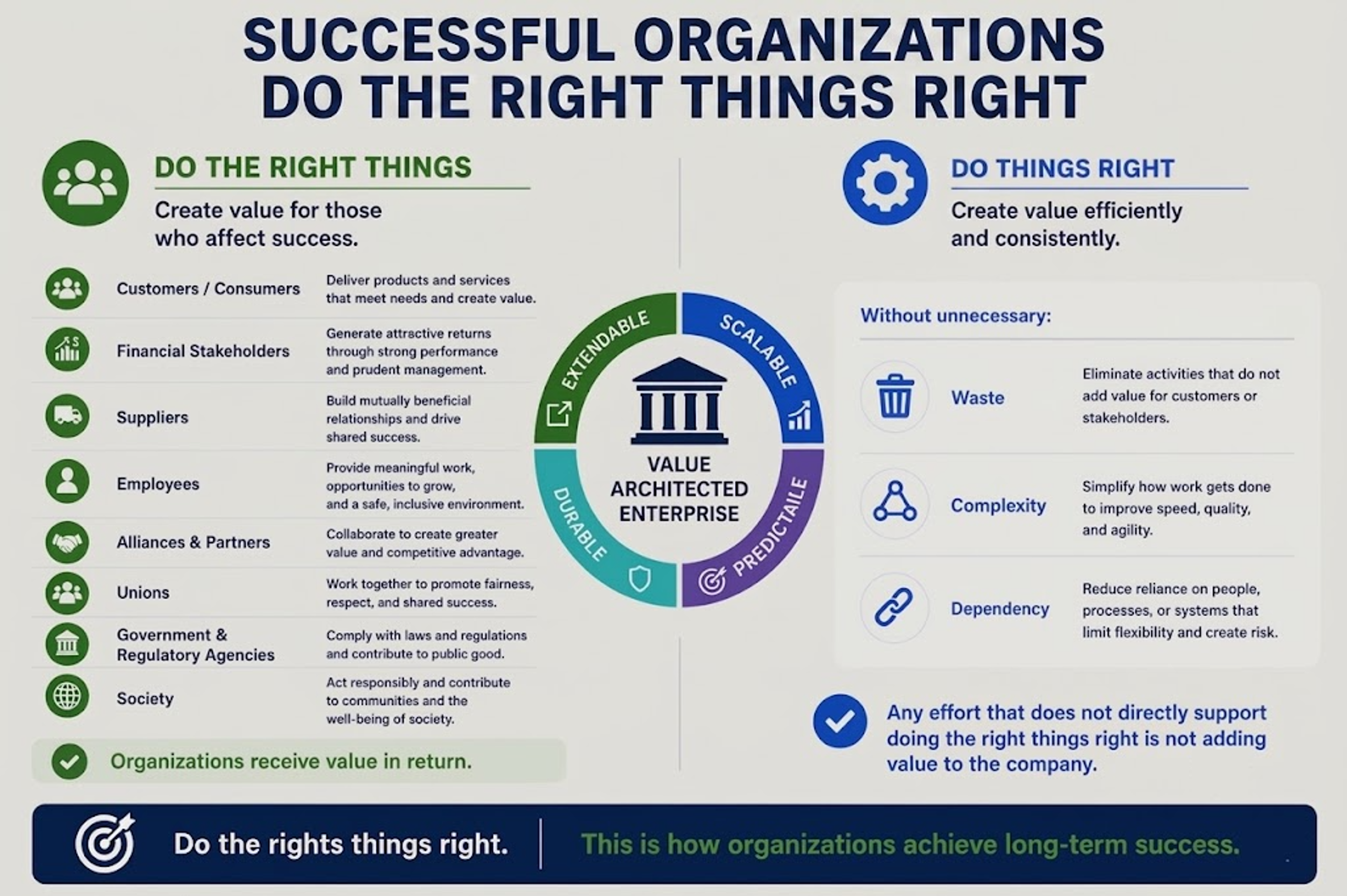
Successful organizations do the right things right.
They create value for those that affect their success and do it efficiently and consistently—without waste, complexity, or dependency.
Organizations must also strengthen their ability to create and adapt value in the future.
At BSO Achieve, we refer to these organizations as Value-Architected Enterprises.
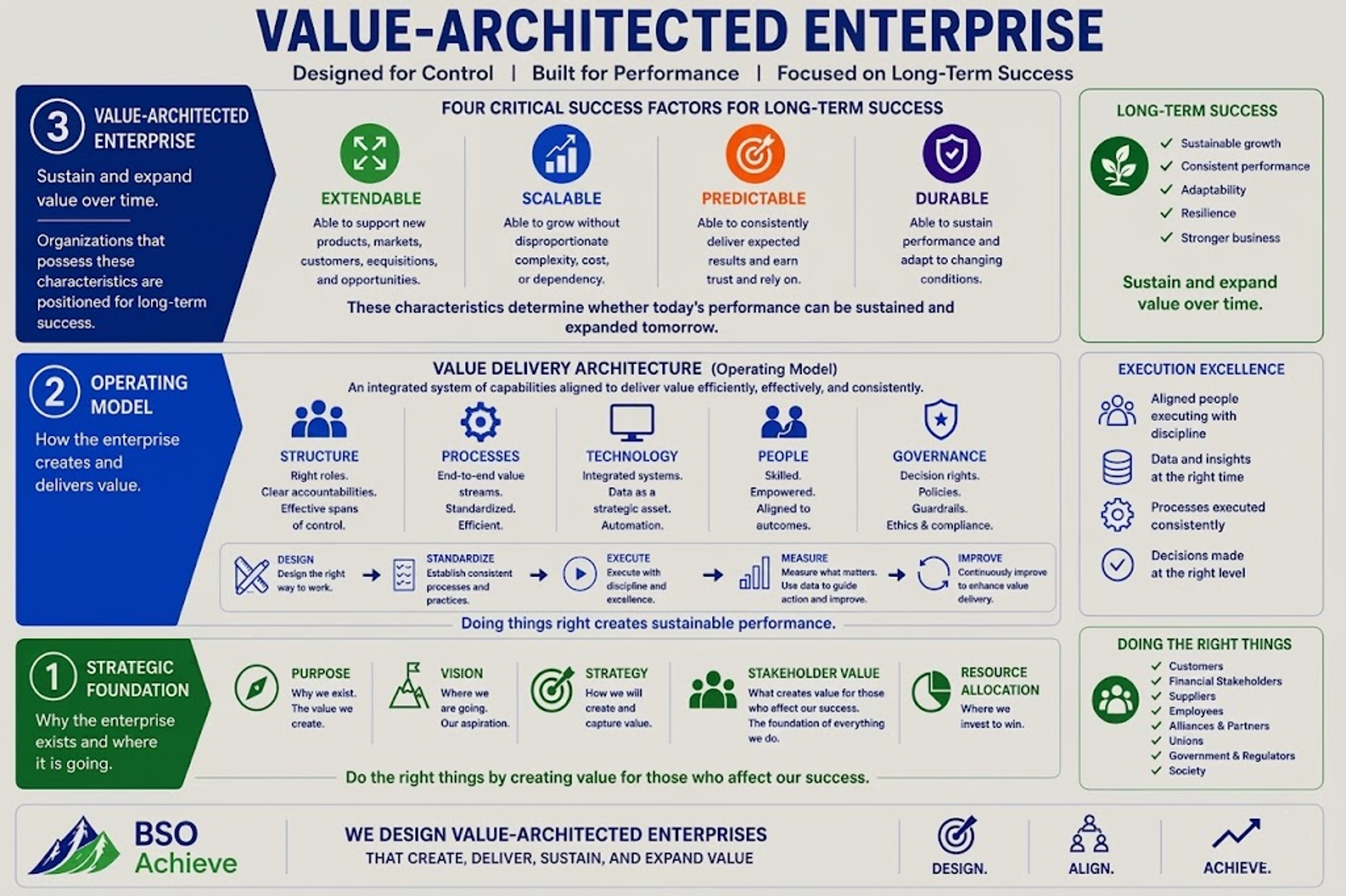
A Value-Architected Enterprise is intentionally designed to create, deliver, sustain, and expand value over time.
Its strategy, processes, systems, governance, organization, and execution are aligned to support four critical success factors for long-term success:
Extendable
Able to support new products, markets, customers, acquisitions, and opportunities.
Scalable
Able to grow without disproportionately increasing complexity, coordination, or management effort
Predictable
Able to consistently deliver expected results.
Durable
Able to sustain performance and adapt to changing conditions.
Together, these characteristics determine whether today's performance can be sustained and expanded tomorrow.
Success is about strengthening the organization's ability to create, deliver, sustain, and expand value over time.
That is the essence of a Value-Architected Enterprise.
Why It Matters
Organizations pursue many objectives.
Improving profitability. Accelerating growth. Increasing productivity. Enhancing customer experiences. Integrating acquisitions. Entering new markets. Implementing new technologies.
These objectives matter.
But improved performance does not necessarily create a stronger business.
Margins can improve through cost cutting.
Productivity can increase through overtime.
Customer service can improve through heroic effort.
Growth can create complexity.
Problems can be solved through manual workarounds.
Performance may improve.
Yet the organization may become more dependent on key individuals, more difficult to manage, less adaptable to change, and increasingly constrained by the operating model that supports it.
A stronger business is one that can consistently achieve its intended business outcomes while adapting to growth, opportunity, and change.
Success is measured not simply by improved performance, but by whether each strategic initiative leaves the organization better positioned to grow, adapt, execute consistently, and sustain success over time.
Is Your Operating Model Supporting Long-Term Success?
Long-term success depends on more than individual initiatives or short-term improvements.
It depends on an operating model designed to create, deliver, sustain, and expand value over time.
If your organization is struggling to scale, experiencing inconsistent performance, or finding growth increasingly difficult to manage, it may be time to challenge the assumptions underlying the business.
BSO Achieve helps organizations become more Extendable, Scalable, Predictable, and Durable.
Design. Align. Achieve.