
Organization Alignment
Align the Organization to Achieve the Intended Outcomes
Organizations evolve for many reasons—growth, acquisitions, restructuring, new products, new markets, operational improvement, or technology transformation.
These changes often require new roles, responsibilities, decision rights, capabilities, and accountability.
Yet many organizations struggle to achieve the expected results.
Strategies are revised.
Processes are redesigned.
Systems are implemented.
But the organization responsible for executing those changes often remains largely unchanged.
As a result, accountability becomes unclear, decision-making slows, leadership dependency increases, and old behaviors persist. The transformation may be implemented, but the organization never fully transitions.
Organizations frequently experience:
✓ Executive dependency
✓ Slow decision-making
✓ Inconsistent execution
✓ Conflicting priorities
✓ Limited accountability
✓ Reduced adoption of new ways of working
✓ Difficulty scaling operations
✓ Failure to achieve intended business outcomes
Successful transformation requires more than new strategies, processes, and systems.
It requires an organization capable of executing them.
Organization Alignment helps establish the structure, accountability, capabilities, and governance required to execute consistently, adapt to change, and achieve sustainable business performance and increase enterprise value.
Organizations Engage BSO Achieve When:
✓ Growth is creating complexity and leadership dependency
✓ Acquisitions require organizational integration
✓ New products or markets require new capabilities
✓ Existing structures no longer support execution
✓ Roles and accountability are unclear
✓ System implementations require changes to responsibilities and workflows
✓ Organizational changes are needed to support strategic objectives
Our Approach
Organization Alignment begins with a simple principle:
People, governance, and accountability must be aligned with the way the business intends to operate.
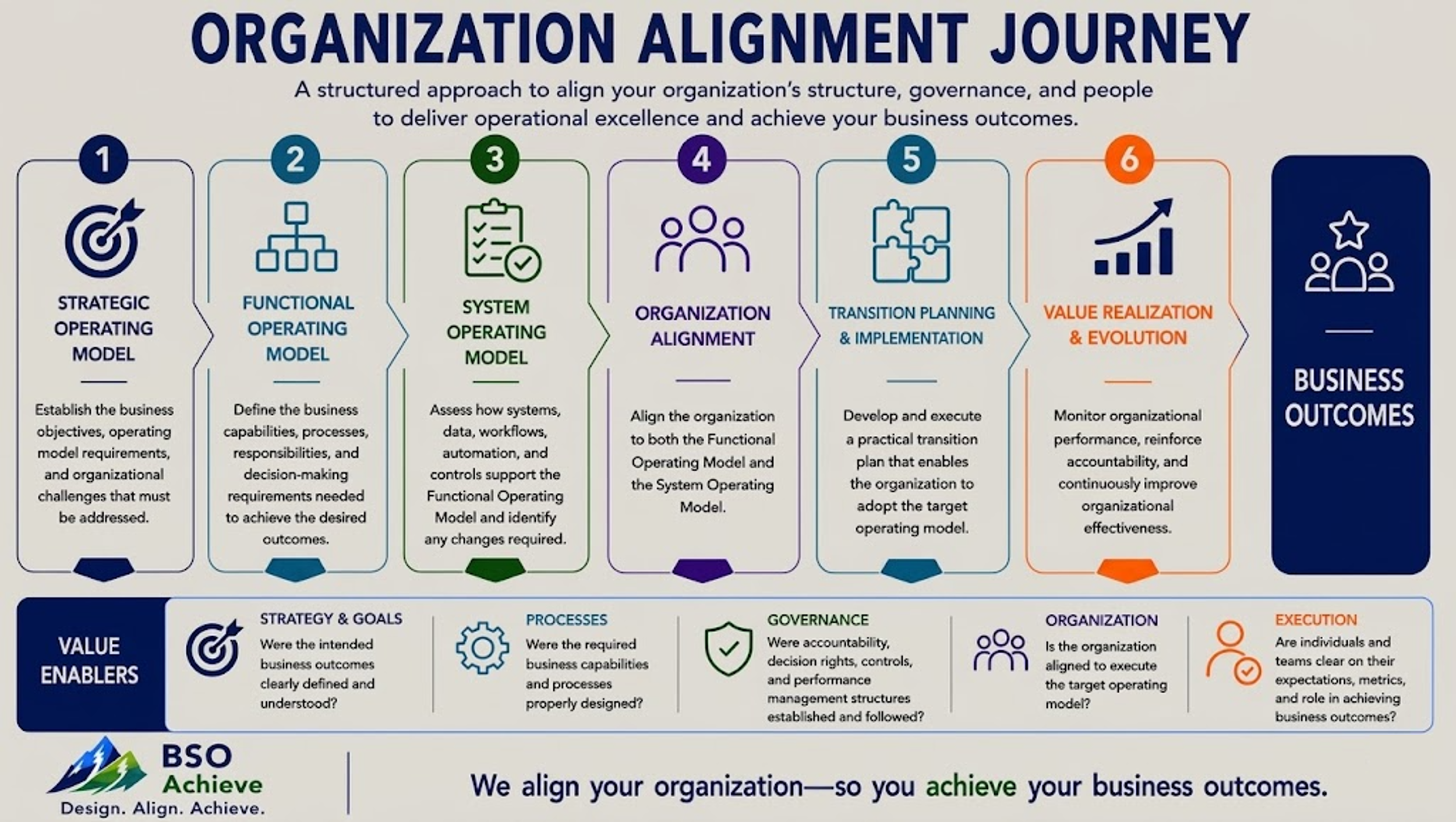
Our approach focuses on aligning five critical dimensions:
Strategy & Goals
Ensuring organizational priorities and responsibilities support the strategic objectives of the enterprise.
Processes
Aligning roles, responsibilities, and decision-making authority with the processes required to achieve desired outcomes.
Governance
Establishing clear accountability, decision rights, performance management, and control structures.
Organization
Designing organizational structures, leadership responsibilities, and reporting relationships that support execution.
Execution
Ensuring individuals and teams understand expectations, performance measures, and their role in achieving business outcomes.
When these dimensions are aligned, organizations become more scalable, predictable, and durable.
How We Do It
Organization alignment is not simply an organizational design exercise.
Many organizations attempt to improve performance by changing reporting structures, redefining roles, or hiring additional resources. However, organizational performance is ultimately determined by how well the organization supports the operating model it is expected to execute.
Our approach begins by understanding the business objectives, operating model requirements, and organizational challenges that must be addressed. We then align organizational structure, capabilities, governance, accountability, and execution responsibilities to support both the Functional Operating Model and the System Operating Model.
Strategic Operating Model
Establish the business objectives, operating model requirements, and organizational challenges that must be addressed.
Focus Areas
✓ Business objectives and expected outcomes
✓ Growth, acquisition, restructuring, or market expansion requirements
✓ Organizational capabilities required for success
✓ Organizational design principles
✓ Governance and accountability requirements
✓ Expected challenges, risks, and constraints
Functional Operating Model
Define the business capabilities, processes, responsibilities, and decision-making requirements needed to achieve the desired outcomes.
Focus Areas
✓ Business capabilities
✓ End-to-end processes
✓ Cross-functional coordination
✓ Decision rights
✓ Accountability requirements
✓ Process ownership
System Operating Model
Assess how systems, data, workflows, automation, and controls support the Functional Operating Model and identify any changes required to improve execution.
Focus Areas
✓ System-enabled processes
✓ Data requirements
✓ Workflow design
✓ Automation opportunities
✓ Controls and visibility
✓ Information required for decision-making
Organization Operating Model
Align the organization to both the Functional Operating Model and the System Operating Model.
Focus Areas
✓ Organizational structure
✓ Roles and responsibilities
✓ Decision rights and accountability
✓ Governance responsibilities
✓ Capability requirements
✓ Span of control and reporting relationships
Transition Planning & Implementation
Develop and execute a practical transition plan that enables the organization to adopt the target operating model.
Focus Areas
✓ Organizational transition planning
✓ Change management
✓ Communication planning
✓ Training and readiness
✓ Leadership alignment
✓ Adoption monitoring
Value Realization & Evolution
Monitor organizational performance, reinforce accountability, and continuously improve organizational effectiveness.
Focus Areas
✓ KPI and performance monitoring
✓ Governance effectiveness
✓ Accountability reinforcement
✓ Organizational capability development
✓ Continuous improvement
✓ Ongoing operating model evolution
Typical Benefits
Organizations that engage BSO Achieve benefit from:
✓ Reduced executive dependency
✓ Clearer accountability and ownership
✓ Faster and more effective decision-making
✓ Improved cross-functional alignment
✓ Greater organizational scalability
✓ Increased operational predictability
✓ Improved execution consistency
✓ Stronger adoption of transformation initiatives
✓ Higher enterprise value
Transformation Success Depends on Organizational Alignment
Organizations rarely fail because they lack strategy.
They rarely fail because they lack technology.
More often, they fail because the organization responsible for execution was never fully aligned with the intended outcome.
BSO Achieve helps organizations ensure that strategy, governance, accountability, and execution work together to achieve lasting business results.
Want to Align Your Organization for Sustainable Performance?
Whether supporting growth, restructuring, acquisitions, or changing business requirements, BSO Achieve helps organizations align roles, accountability, and ways of working with the operating model required for success.