
Business & System Transformation
Transform the Business, Not Just the System
Organizations transform for many reasons—growth, acquisitions, restructuring, new products, new markets, operational improvement, or technology modernization.
Yet many transformation initiatives fail to deliver the expected business outcomes.
Projects may go live on time and within budget, but organizations often continue to experience operational complexity, executive dependency, inconsistent execution, fragmented processes, limited visibility, and difficulty scaling.
The challenge is rarely the technology itself.
More often, transformation struggles because organizations begin with solutions before fully defining how they intend to operate. Existing processes are carried forward without challenge. Accountability remains unclear. System capabilities become misaligned with business requirements. Success becomes measured by implementation milestones rather than business outcomes.
Business and system transformation requires more than implementing technology.
It requires designing and aligning the operating model needed to execute strategy and achieve the desired results.
Organizations Engage BSO Achieve When:
✓ Systems no longer support strategic objectives.
✓ Growth requires new capabilities.
✓ Acquisitions require integration.
✓ New markets or products require new operating models.
✓ Existing processes are limiting performance.
✓ Organizational structures no longer support execution.
✓ Transformation initiatives require independent guidance.
Our Approach
BSO Achieve approaches transformation from a business-first perspective.
Before evaluating technology decisions, we help organizations define the operating model, organizational requirements, governance structures, and performance objectives needed to support strategic goals.
This ensures transformation efforts are designed to achieve business outcomes rather than simply implement technology.
Our approach focuses on aligning five critical dimensions:
Strategy & Goals
Establishing clear business objectives, desired outcomes, and enterprise value priorities that guide transformation decisions.
Processes
Designing and aligning business processes to support the organization's strategic and operational requirements.
Governance
Defining decision rights, accountability, controls, and performance management structures required for effective execution.
Systems
Ensuring enterprise platforms and technologies support the operating model and business objectives.
Organization
Aligning organizational structure, roles, responsibilities, and capabilities with the target operating model.
When these five dimensions are aligned, organizations are better positioned to achieve scalable, predictable, and sustainable business outcomes.
How We Do It
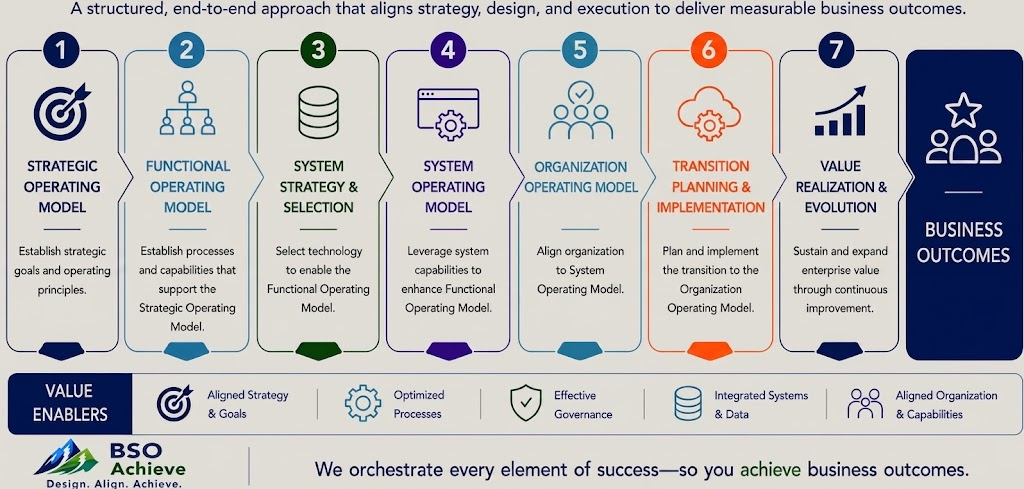
BSO Achieve supports organizations throughout the transformation lifecycle, from strategy development through value realization.
Strategic Operating Model
Establish where the company wants to be in three years; what is needed to get there; the expected challenges; and the roadmap. Define the business outcomes, enterprise value objectives, strategic priorities, and operating principles required to support future growth and performance.
Focus Areas
✓ Three-Year Vision and Strategic Objectives
✓ Current Challenges and Limits to Growth
✓ Operating Model Requirements
✓ Key Risks and Challenges
✓ KPIs and Accountability
✓ Strategic Roadmap
Functional Operating Model
Design the capabilities, processes, governance structures, performance measures, and organizational requirements needed to execute the strategy.
Focus Areas
✓ Capability assessment and design
✓ Process architecture
✓ Governance and decision frameworks
✓ Performance management requirements
✓ Accountability structures
System Strategy & Selection Support
Determine whether existing systems can support future business requirements and assist with evaluating and selecting new platforms when necessary.
Focus Areas
✓ Current-state system assessment
✓ Business and functional requirements
✓ Capability gap analysis
✓ Platform evaluation and selection
✓ Vendor assessment and decision support
System Operating Model
Define how systems, data, workflows, integrations, controls, and reporting structures will support the target functional operating model.
Focus Areas
✓ System-enabled business processes
✓ Data requirements and visibility
✓ Reporting and analytics requirements
✓ Integration requirements
✓ Control and governance requirements
Organization Alignment
Align organizational structure, roles, accountability, and leadership responsibilities with the target system operating model, which has been aligned to the target functional model that was developed to support the Strategic Operating Model. This becomes the Organization Operating Model – the executable version.
Focus Areas
✓ Organizational design
✓ Roles and responsibilities
✓ Accountability alignment
✓ Leadership and decision structures
✓ Change readiness
Transition Planning & Implementation
Support execution through governance, planning, risk management, stakeholder alignment, and transformation leadership.
Focus Areas
✓ Transformation governance
✓ Program and initiative planning
✓ Risk and issue management
✓ Executive alignment
✓ Organizational adoption
Value Realization & Evolution
Establish the controls, measurements, and continuous improvement mechanisms required to ensure intended business outcomes are achieved and sustained.
Focus Areas
✓ KPI and performance measurement
✓ Benefits realization
✓ Operational controls
✓ Continuous improvement
✓ Future-state evolution planning
Typical Benefits
Organizations that engage BSO Achieve benefit from:
✓ Improved alignment between strategy, operations, and technology
✓ Greater scalability and operational consistency
✓ Reduced complexity and executive dependency
✓ Improved visibility and decision-making
✓ Higher adoption and utilization of enterprise systems
✓ Faster realization of business benefits
✓ Increased organizational predictability
✓ Stronger enterprise value creation
Technology Alone Does Not Create Results
Technology can enable transformation.
It cannot create business success on its own.
Successful transformation occurs when strategy, processes, governance, data, systems, and organizational execution are intentionally designed to work together.
BSO Achieve helps organizations ensure their transformation efforts deliver more than system success.
We help them achieve business success.
Want to Achieve More Than a Successful Go-Live?
Technology alone does not create business success. BSO Achieve helps organizations align strategy, processes, governance, systems, and organization to deliver the outcomes transformations are intended to achieve.