
Strategy & Value Architecture
Build a Stronger Business
Organizations pursue growth, acquisitions, new products, new markets, operational improvements, and technology investments to strengthen their businesses and position themselves for long-term success.
Yet determining the right strategic initiatives can be difficult.
Organizations often struggle to identify which opportunities will create the greatest value, which initiatives deserve immediate attention, what capabilities will be required, and how success should be measured.
Without these connections, strategies often become presentations rather than results.
We help organizations challenge assumptions, clarify strategic objectives, identify and prioritize the initiatives that create the greatest value, and establish the operating model capabilities required to execute them successfully.
At BSO Achieve, we challenge strategic initiatives through the lens of building a stronger business—one that becomes more Extendable, Scalable, Predictable, and Durable as a result of the decisions made today.
Because the ultimate objective is not simply achieving today's goals.
It is about building a stronger business that increases the organization's ability to create, deliver, sustain, and expand value over time.
Organizations Engage BSO Achieve When:
✓ Growth opportunities require greater strategic focus
✓ Leadership teams need alignment on priorities and objectives
✓ New products, markets, or acquisitions require new capabilities
✓ Resources must be focused on the initiatives that create the greatest value
✓ Existing operating models no longer support future objectives
✓ Technology investments need to support business strategy
✓ Strategic initiatives require a roadmap for execution
Our focus is helping organizations identify the right strategic initiatives and establish the operating model capabilities required to execute them and build a stronger business.
Our Approach
Most strategic planning processes focus on defining goals.
We focus on defining the initiatives, operating model requirements, governance structures, and accountability needed to achieve those goals.
Many organizations leave strategic planning sessions with a long list of ideas but limited clarity regarding priorities, ownership, required changes, or expected business outcomes. As a result, strategic initiatives compete for resources, execution becomes fragmented, and desired results fail to materialize.
Our approach connects strategy to execution by identifying the initiatives most likely to improve business performance and build a stronger business that will create, deliver, sustain, and expand value over time,
We help leadership teams:
• Establish clear strategic priorities
• Identify the initiatives that create the greatest value
• Differentiate immediate execution priorities from future growth opportunities
• Define the operating model requirements needed to support success
• Establish accountability, governance, and performance measures
• Create a roadmap that connects strategy to measurable business outcomes
The result is a practical, executable framework that enables organizations to focus resources, align decision-making, and continuously improve both business performance and enterprise value.
For execution, our approach focuses on aligning five critical dimensions:
Strategy & Goals
Establishing clear business objectives, desired outcomes, and initiatives that guide transformation decisions.
Processes
Designing and aligning business processes to support the organization's strategic and operational requirements.
Governance
Defining decision rights, accountability, controls, and performance management structures required for effective execution.
Systems
Ensuring enterprise platforms and technologies support the operating model and business objectives.
Organization
Aligning organizational structure, roles, responsibilities, and capabilities with the target operating model.
When these five dimensions are aligned, organizations are better positioned to achieve scalable, predictable, and sustainable business outcomes.
How We Do It
We help organizations translate strategy into executable plans that improve business performance and support long term success.
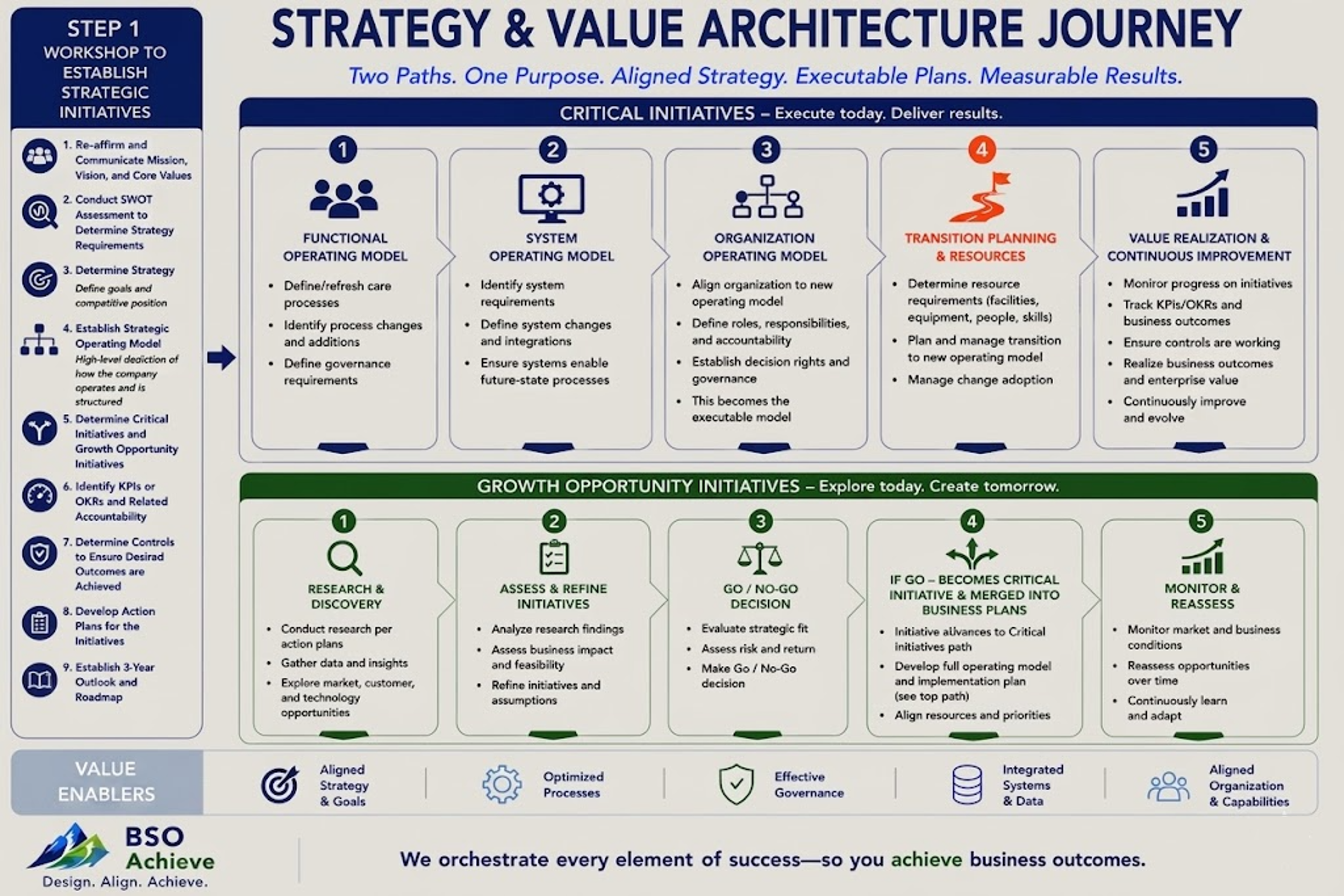
The journey begins with executive alignment and strategic planning, where leadership establishes business objectives, priorities, strategic requirements, success measures, and the Strategic Operating Model required to achieve them.
From there, initiatives are organized into two complementary paths.
Critical Initiatives
Critical Initiatives are the highest-priority actions leadership believes will improve business performance and create enterprise value within the next 12 months.
These initiatives typically require changes to processes, governance, systems, organizational structure, accountability models, or resource allocation.
Examples include:
• Expanding sales within existing accounts
• Cross-selling additional products and services
• Improving lead generation and sales conversion
• Reducing scrap
• Increasing manufacturing throughput
• Improving inventory performance
For Critical Initiatives, we help organizations design the Functional Operating Model, define system requirements, align organizational structure and governance, establish implementation plans, and monitor progress toward business outcomes.
Growth Opportunity Initiatives
Growth Opportunity Initiatives are longer-term opportunities that require investigation, research, validation, or market testing before significant investment decisions are made.
Examples include:
• New product concepts
• New market opportunities
• AI initiatives
• Strategic partnerships
• Geographic expansion opportunities
• New business models
These initiatives move through a structured discovery and evaluation process that assesses strategic fit, business impact, feasibility, risk, and potential return.
When approved, Growth Opportunity Initiatives become Critical Initiatives and enter the execution path.
Continuous Value Creation
Throughout the journey, we ensure strategy, processes, governance, systems, data, and organizational capabilities remain aligned to the desired business outcomes.
The result is a structured value creation roadmap that helps organizations focus resources, execute with confidence and increase enterprise value through greater Extendibility, Scalability, Predictability, and Durability.
Typical Benefits
Organizations that complete a Strategy & Value Architecture engagement typically achieve:
✓ Clear strategic priorities
✓ Improved executive alignment
✓ Better investment decisions
✓ Stronger governance and accountability
✓ Reduced initiative overload
✓ More effective resource allocation
✓ Increased EBITDA and EBITDA Multiple performance
✓ Improved enterprise value
✓ A roadmap connecting strategy to execution
✓ Greater organizational focus and execution capability
Is This Service Right For You?
Strategy & Value Architecture is often appropriate when:
Growth has slowed or become difficult to manage
Multiple initiatives compete for resources
Leadership lacks alignment on priorities
Enterprise value is lower than expected
A major transformation is being considered
An acquisition strategy is being developed
New products or markets are being evaluated
The organization needs a clear roadmap for growth
How Do You Know Your Strategy Will Build a Stronger Business?
Strategic initiatives are often selected based on urgency, intuition, or departmental priorities.
But how do you know which initiatives will create the greatest value?
How do you know what capabilities will be required?
How do you challenge assumptions before making investments?
And how do you know whether today's decisions will strengthen the business over the long term?
BSO Achieve helps organizations establish strategy, prioritize initiatives, and design the operating model capabilities required for long-term success.