Why Transformations Fail
The Problem Is Rarely the Initiative
Organizations invest heavily in ERP systems, CRM platforms, AI initiatives, acquisitions, restructuring efforts, and business transformation programs.
Many of these initiatives are completed.
Far fewer achieve the business outcomes originally expected.
Projects may finish.
Systems may go live.
Organizations may continue to struggle.
Why?
Because transformation success requires more than implementation success.
It requires organizational alignment.
At BSO Achieve, we have found that transformation failures are rarely caused by the initiative itself.
More often, they result from how the initiative was designed, aligned, governed, and executed across the organization.
The specific initiative may differ.
The underlying causes of failure are often remarkably similar.
The Cost of Transformation Failure
When transformations fail to deliver expected outcomes, organizations often experience:
Increased operational complexity
Executive dependency
Reduced employee confidence
Weak adoption
Missed growth opportunities
Delayed business benefits
Escalating costs
Lower enterprise value
The consequences frequently extend far beyond the original project.
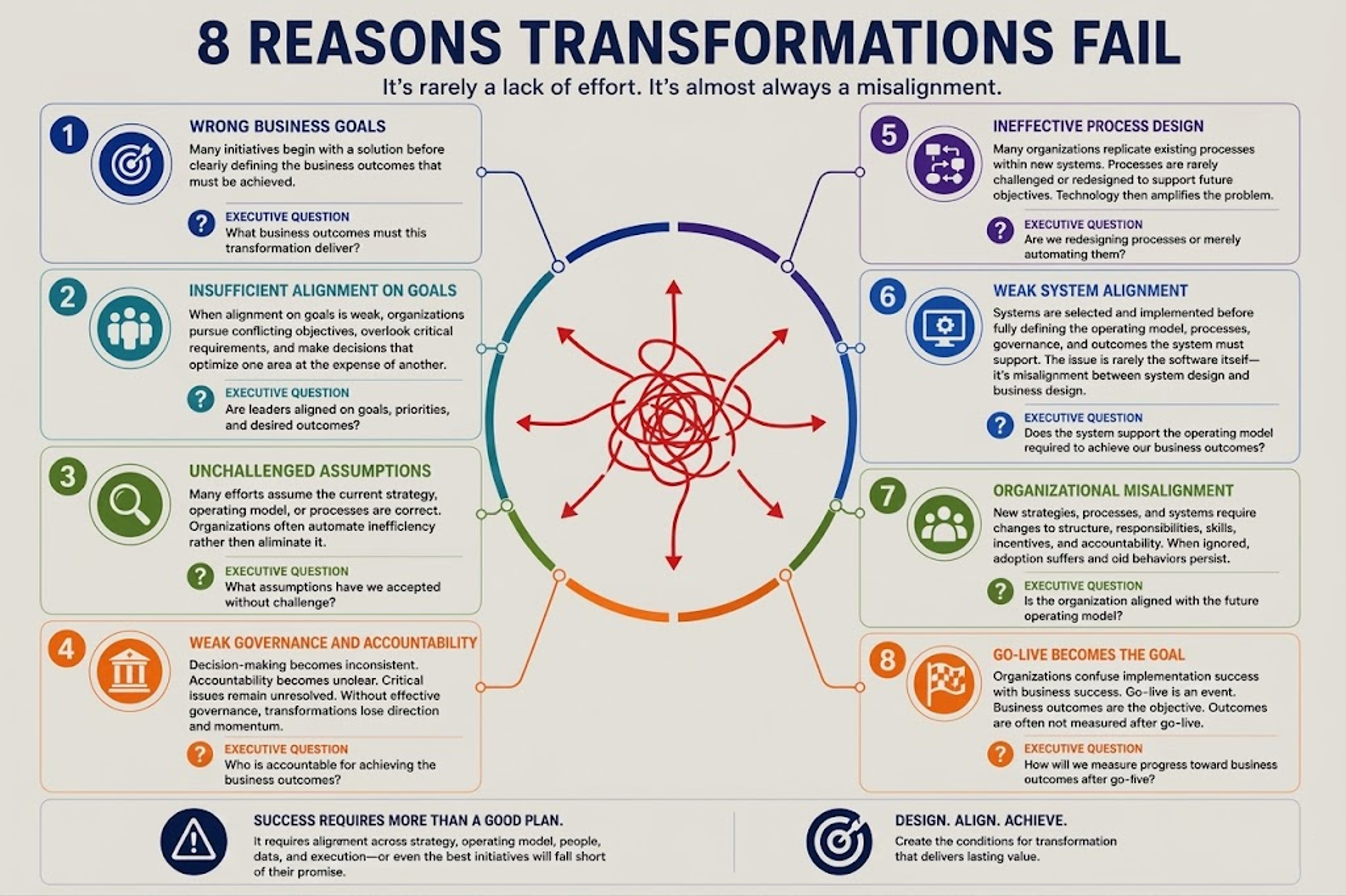
The Eight Causes of Transformation Failure
1. Wrong Business Goals
Many initiatives begin with a solution before clearly defining the business outcomes that must be achieved.
Organizations focus on implementing systems, restructuring departments, acquiring companies, or deploying new technologies without establishing measurable business objectives.
When the destination is unclear, success becomes difficult to define and even harder to achieve.
Executive Question
What business outcomes must this transformation deliver?
2. Insufficient Alignment on Goals
Transformation initiatives often involve multiple leaders, functions, stakeholders, and priorities.
When alignment on goals is weak, organizations pursue conflicting objectives, overlook critical requirements, and make decisions that optimize one area at the expense of another.
Misalignment creates friction throughout the transformation effort and often prevents organizations from achieving the outcomes they originally intended.
Executive Question
Are leaders aligned on goals, priorities, and desired outcomes?
3. Unchallenged Assumptions
Many transformation efforts assume the current strategy, operating model, organizational structure, governance model, or processes are fundamentally correct.
As a result, existing limitations are carried forward into the future state.
Organizations often automate inefficiency rather than eliminate it.
Executive Question
What assumptions have we accepted without challenge?
4. Weak Governance and Accountability
Organizations frequently underestimate the importance of governance.
Decision-making becomes inconsistent.
Accountability becomes unclear.
Critical issues remain unresolved.
Without effective governance, transformations lose direction and momentum.
Executive Question
Who is accountable for achieving the business outcomes?
5. Ineffective Process Design
Many organizations simply replicate existing processes within new systems.
Processes are rarely challenged, simplified, or redesigned to support future objectives.
As a result, inefficiencies remain embedded within the organization.
Technology then amplifies the problem.
Executive Question
Are we redesigning processes or merely automating them?
6. Weak System Alignment
Organizations often focus on selecting and implementing systems before fully defining the operating model, processes, governance, accountability, and business outcomes the system must support.
As a result, the system is configured to support existing practices rather than the future-state operating model required to achieve the desired outcomes.
The issue is rarely the software itself.
More often, it is the lack of alignment between the system design and the business design.
Executive Question
Does the system support the operating model required to achieve our business outcomes?
7. Organizational Misalignment
New strategies, processes, and systems frequently require changes to organizational structure, responsibilities, skills, incentives, and accountability.
When organizational alignment is ignored, adoption suffers and old behaviors persist.
The transformation may be implemented.
The organization may never fully transition.
Executive Question
Is the organization aligned with the future operating model?
8. Go-Live Becomes the Goal
Perhaps the most common failure occurs when organizations confuse implementation success with business success.
Go-live is an event.
Business outcomes are the objective.
Organizations often celebrate implementation milestones while failing to monitor whether the desired business outcomes are actually being achieved.
Executive Question
How will we measure progress toward business outcomes after go-live?
The Value-Architected Enterprise
Enterprise value is not created by isolated improvements.
It is created through the alignment of business strategy, operating models, governance, processes, systems, data, accountability, and organizational execution.
Organizations that consistently achieve successful transformation outcomes intentionally design these elements to work together toward common business outcomes.
We refer to this as the Value-Architected Enterprise.
Rather than optimizing individual components independently, value-architected organizations design and align the enterprise as an integrated system.
This creates the foundation required to become more:
Extendable
Scalable
Predictable
Durable
Why Successful Transformations Are Different
Successful transformations align:
Business strategy
Governance
Operating models
Processes
Systems
Data
Accountability
Organizational execution
When these elements work together, organizations are better positioned to achieve business outcomes and increase enterprise value.
When they do not, even well-executed projects struggle to deliver lasting results.
Successful transformations recognize that technology, acquisitions, restructuring efforts, and growth initiatives are not the objective.
The objective is achieving the business outcomes they are intended to deliver.
How BSO Achieve Helps
BSO Achieve helps organizations identify and address the underlying causes of transformation failure before they become costly outcomes.
Our work spans:
Enterprise Value Assessment
Strategic Planning
Operating Model Design
Organizational Alignment
Enterprise System Strategy
Transformation Execution
Transformation Recovery
We help organizations move beyond implementation success and achieve measurable business outcomes.
Before Your Next Transformation
Before investing in technology, integrating an acquisition, restructuring operations, or launching a transformation initiative, ask a simple question:
Is the organization designed to achieve the outcomes we want?
The answer often determines whether transformation creates lasting value—or simply creates more change.