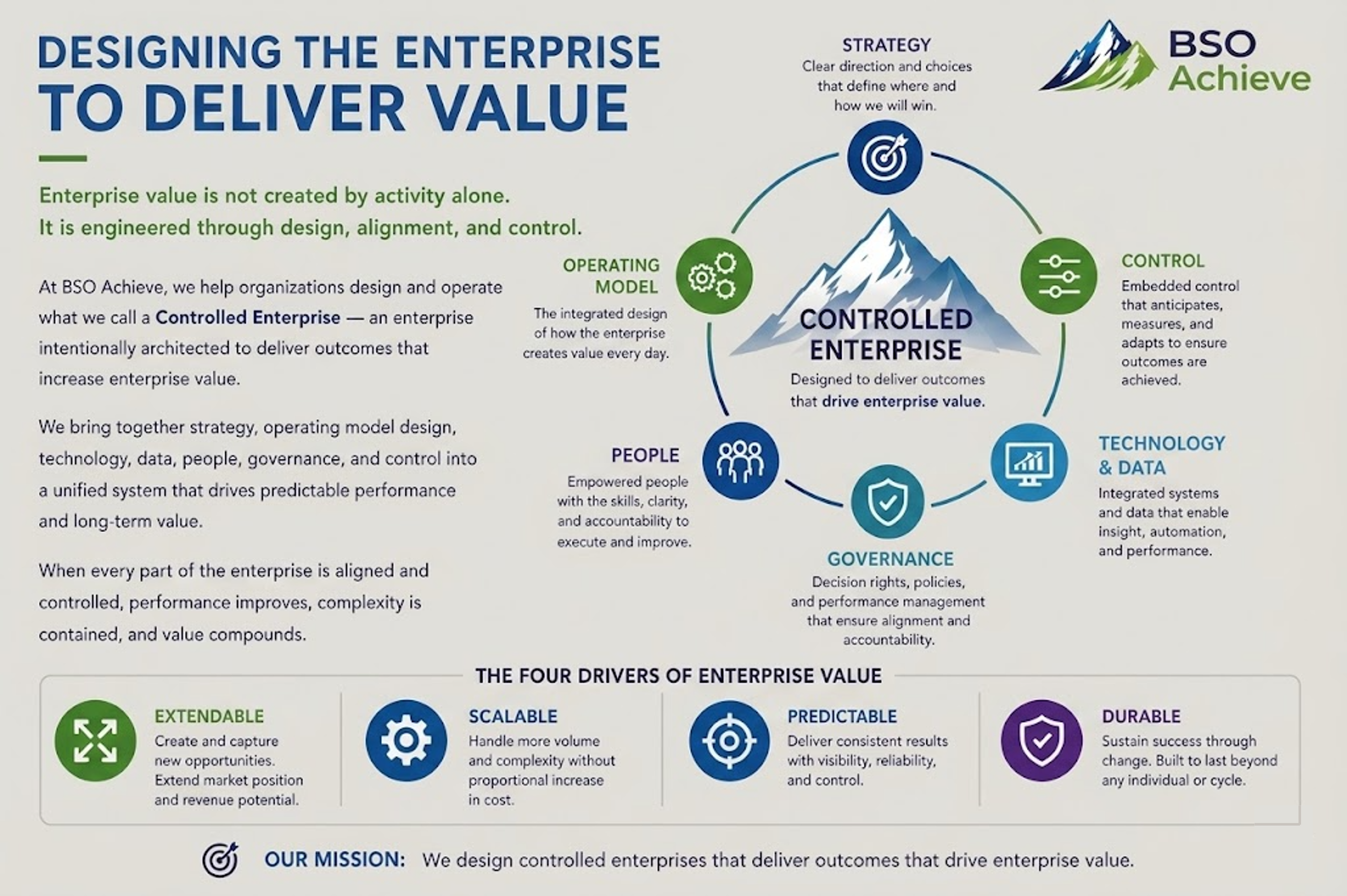
Drive Enterprise Value
BSO Achieve aligns business strategy, operations, systems, and organizational execution to ensure transformations deliver measurable business outcomes that drive enterprise value.
The Problem Most Organizations Face
System efforts encounter business transformation challenges that impede business outcomes.
Wrong business goals; insufficient alignment
Weak control processes
Existing processes not challenged
Invalid or incomplete data
No organizational alignment
Many organizations invest heavily in strategy, systems, and transformation initiatives yet struggle to achieve lasting business outcomes. Systems fail to deliver expected results. Leadership teams work harder but experience less control over performance.
The root cause is rarely execution effort or technology selection.
Most companies are operating without an integrated operating model designed to reliably produce enterprise value.
An organization improves when its entire enterprise operates as a controlled system aligned to measurable outcomes.
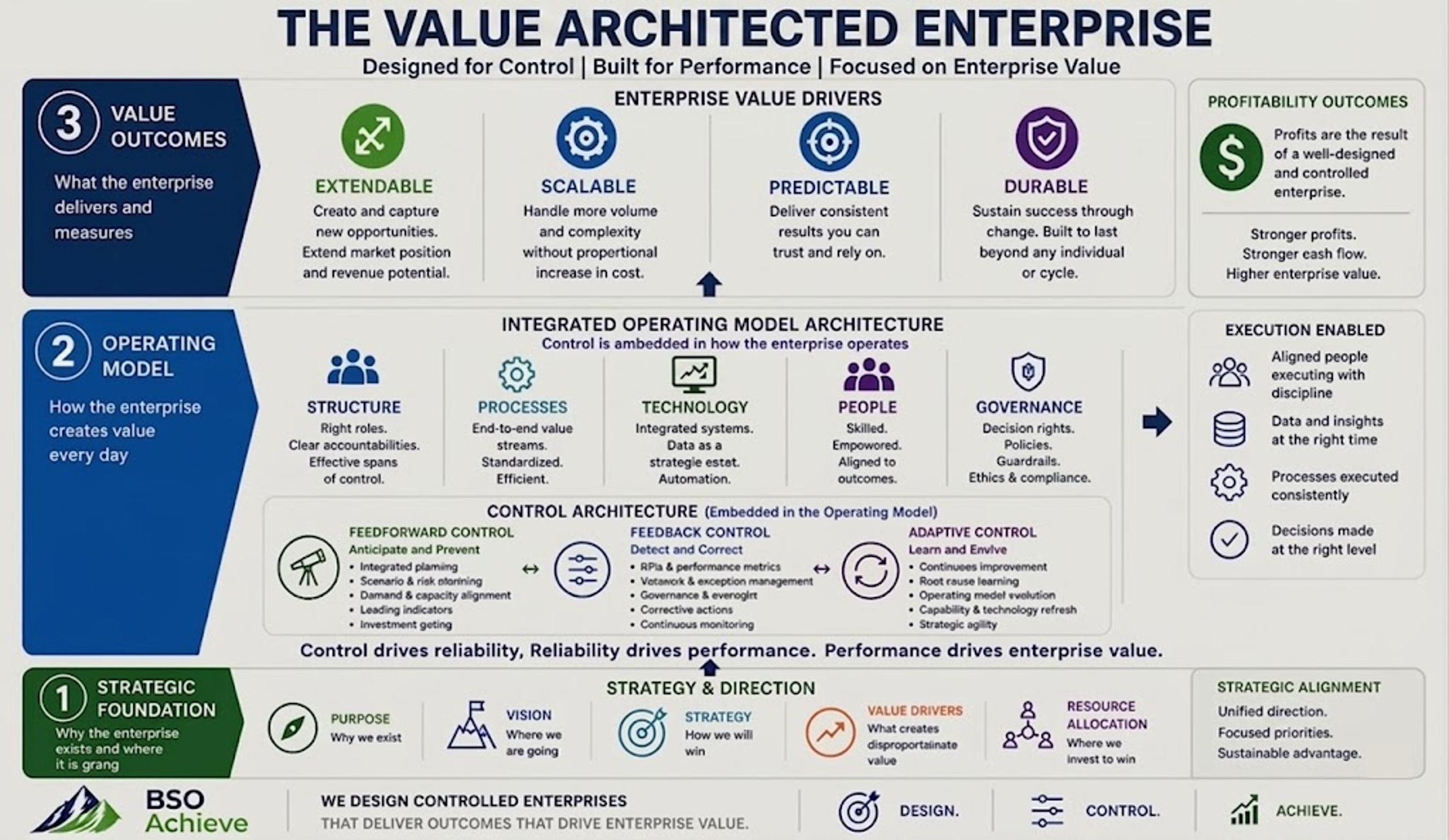
The BSO Achieve Value Architected Enterprise Model
The diagram represents how successful organizations operate through three integrated layers.
-
Every controlled enterprise begins with clarity of direction. Purpose, vision, strategy, and value drivers establish where the organization intends to win and where resources should be invested.
Without this foundation, even well-executed initiatives fail to compound value. Strategy must define not only ambition, but the economic logic that drives enterprise value creation.
-
The Operating Model translates strategy into daily execution.
This includes the alignment of:
organizational structure and decision rights
end-to-end business processes
enabling technology and data platforms
people capabilities and accountability
governance and performance management
Unlike traditional approaches, control is embedded directly within the operating model. The organization is designed not just to operate, but to continuously manage and improve its own performance.
-
When strategy and operating model are aligned and controlled, outcomes become predictable rather than accidental.
The enterprise consistently delivers measurable business results such as revenue growth, margin expansion, cash generation, and risk reduction — outcomes that directly increase enterprise value and investor confidence.
Control: The Missing Discipline in Most Transformations
Most transformation efforts focus on change implementation but overlook control design.
BSO Achieve integrates Control Theory into enterprise architecture through three reinforcing control mechanisms:
Feedforward Control delivers early signals that align resources before execution begins.
Feedback Control measures performance, detects variance, and drives corrective action.
Adaptive Control enables the organization to learn, evolve, and remain effective over time.
Control transforms an operating model from a static design into a living system capable of sustained performance.
Transformation for Enterprise Performance
Technology implementations and process redesign efforts succeed only when they operate within a controlled enterprise framework.
BSO Achieve does not simply implement change.
We design enterprises that reliably deliver outcomes.
By integrating strategy, operating architecture, and control into a single system, organizations gain clarity, alignment, and operational confidence — turning transformation into measurable enterprise value.