
When to Transform
Does Your Business Need Improvement—or Transformation?
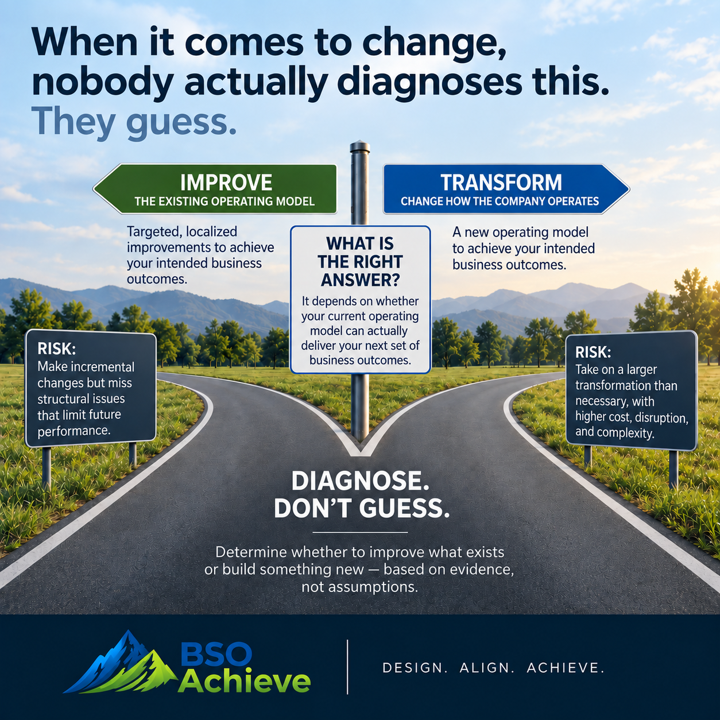
Improvement makes the existing Operating Model work better. Transformation changes the Operating Model because the business needs to operate differently.
The distinction isn't the size, cost, or importance of an initiative. It is the scope of change required to achieve the intended business outcome.
When Improvement Is the Right Answer
Improvement is appropriate when the existing Operating Model is capable of achieving the intended outcome and the required changes can be made without creating conflicts or adverse consequences elsewhere in the business.
But businesses are interconnected. Improving one component can negatively affect another.
An improvement is only an improvement if it improves the business—not merely the component being optimized.
This is why improvement should be evaluated by its impact on the business as a whole—not just the process, function, or system being improved.
When Transformation Is Required
Transformation is required when the existing Operating Model is not capable of achieving the intended business outcome.
It may also be required when improvements that appear targeted cannot be made without creating conflicts or adverse consequences elsewhere—requiring multiple components of the Operating Model to change together.
Transformation isn't defined by the initiative. It is defined by the change required in how the business operates.
Growth, acquisitions, ERP, AI, new markets, restructuring, and strategic change may create the need for transformation. But none of these automatically constitutes transformation.
Initiatives are mechanisms for changing the business. The Business Is the Solution.
How Do You Know When to Transform?
The decision is fundamentally:
Improve when the existing business can achieve the outcome. Transform when the business must operate differently.
Not Sure Whether to Improve or Transform?
The critical question is whether your existing Operating Model can achieve the intended business outcome with targeted improvements—or whether achieving it requires designing a new Operating Model.
BSO Achieve's Business Outcome Readiness Assessment helps leadership make that determination.
We start with the intended business outcome, identify the critical success factors required to achieve it, and assess whether the existing Operating Model can satisfy those requirements.
Business Outcome → Critical Success Factors → Operating Model Assessment → Improve or Transform → Recommended Roadmap
If the answer is Improve
The existing Operating Model is capable of achieving the outcome. The roadmap identifies and prioritizes the targeted improvements required to close specific gaps and strengthen performance.
If the answer is Transform
The existing Operating Model cannot reasonably achieve the outcome through targeted improvements alone. The roadmap identifies the changes required to create a new Operating Model designed to deliver the intended outcome.
The objective is to determine the level of change actually required to achieve the business outcome—and provide a roadmap for getting there.
Typically 2–3 weeks. Defined scope. Fixed fee.
How BSO Achieve Helps
BSO Achieve is focused on situations where transformation is required.
We start with the intended business outcome and work backward to determine what must change. We then architect and orchestrate the Operating Model changes required to achieve that outcome.
This is Business Success Orchestration—ensuring that changes to processes, governance, information, systems, organization, and accountability work together around the intended business outcome rather than being designed and implemented independently.
And success has two objectives:
1. Achieve the intended business outcome.
2. Strengthen the business's ability to achieve future outcomes. That means creating a business that is more Extendable, Scalable, Predictable, and Durable.
When transformation is required, BSO Achieve architects and orchestrates the Operating Model changes needed to achieve the intended business outcome and strengthen the business.
Does Your Business Need to Transform?
If achieving your intended business outcome requires the Operating Model to change, the next step is determining what must change and how those changes need to work together.
If you want to determine whether the existing operating model can deliver business outcomes with some improvements please reach out to us for the Business Outcome Readiness Assessment.
BSO Achieve can help assess the current Operating Model, identify the changes required, and determine the appropriate transformation path.