
Initiative Success Isn't Business Success
Successful initiatives often fail to achieve the business outcomes executives expected
Organizations invest millions of dollars every year in strategic initiatives intended to improve their businesses.
They pursue acquisitions, enter new markets, launch new products, implement ERP systems, adopt AI, improve operations, restructure organizations, and invest in growth initiatives.
Every initiative is approved because it is expected to achieve specific business outcomes.
Yet executive surveys consistently show that many business initiatives—including transformation initiatives—fail to deliver the business outcomes that justified the investment.
The surprising part is this:
The problem is often not the initiative itself.
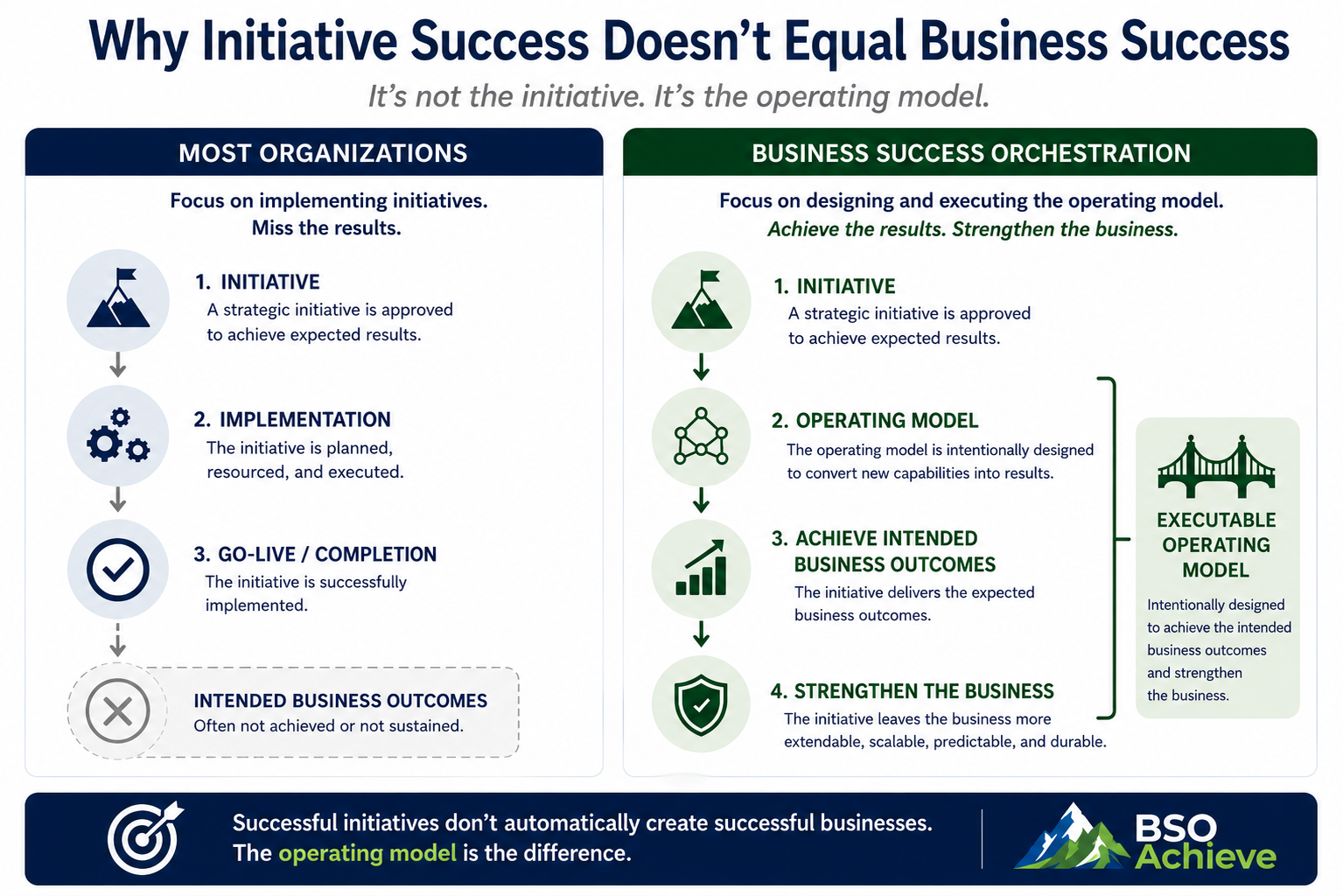
Many initiatives are successfully implemented.
The acquisition closes. The ERP system goes live. The AI solution is deployed. The restructuring is completed.
The initiative is successfully implemented.
The intended business outcomes are not achieved.
Why?
Strategic initiatives create new capabilities.
Capabilities alone do not achieve business outcomes.
Organizations achieve the intended business outcomes only when those capabilities are embedded within an operating model intentionally designed to support them.
Without that alignment, organizations often continue operating much as they did before. Existing processes remain unchanged. Governance continues to reinforce old behaviors. Roles and accountabilities fail to evolve. Decisions are made the same way. Performance measures continue to reward yesterday's priorities.
The initiative introduces new capabilities.
The organization continues to operate the old way.
The intended business outcomes never fully materialize.
The Missing Discipline
Most organizations devote significant attention to selecting and implementing initiatives.
Far less attention is given to redesigning the operating model needed to convert new capabilities into sustained business outcomes.
An operating model is more than a collection of processes or organizational charts.
It defines how strategy, governance, processes, systems, roles, and accountability work together to consistently achieve the intended business outcomes.
When these elements remain misaligned, organizations often experience familiar symptoms:
Strategic initiatives fail to achieve the intended business outcomes.
Improvements prove difficult to sustain.
Growth creates unnecessary complexity.
New initiatives create new capabilities without improving how the business operates.
Organizations become increasingly dependent on individual leaders rather than organizational capability.
The issue is rarely effort.
The issue is alignment.
Designing an Executable Operating Model
Redesigning an operating model is not a single activity.
It is a journey that intentionally aligns the business from strategy through execution.
Strategic Operating Model
Define the intended business outcomes, establish the strategic direction, and determine the capabilities required to achieve them.
Functional Operating Model
Design the processes, governance, decision-making, performance measures, and cross-functional ways of working needed to support those outcomes.
System Operating Model
Configure and optimize technology to enable and enhance the Functional Operating Model—not to define it.
Organization Operating Model
Align roles, responsibilities, skills, organizational structure, and accountability so the organization can consistently execute the operating model.
Together, these elements create the executable operating model—the model the organization executes every day.
Each operating model builds upon the previous one.
When one stage is skipped or receives insufficient attention, organizations often implement new capabilities without achieving the intended business outcomes.
What Defines Business Success?
Successfully implementing an initiative is an important milestone.
It is not the objective.
Business success is achieved when every strategic initiative accomplishes two objectives.
First, achieve the intended business outcomes.
Increase revenue. Improve profitability. Reduce costs. Improve customer satisfaction. Accelerate growth. Improve competitive position.
These are the reasons the initiative was approved.
Second, strengthen the business.
Every initiative should leave the organization better equipped to execute future strategies and respond to future opportunities.
A stronger business becomes:
More Extendable — able to expand into new products, services, markets, and acquisitions with less disruption.
More Scalable — capable of supporting growth without proportional increases in cost or management effort.
More Predictable — able to consistently achieve intended business outcomes through disciplined execution.
More Durable — resilient in the face of leadership changes, market shifts, and operational disruption.
These characteristics are not by-products of successful initiatives.
They are the result of intentionally designing an executable operating model.
Final Thought
Organizations do not become stronger because they complete more initiatives.
They become stronger because every initiative is supported by an executable operating model intentionally designed to achieve its intended business outcomes while strengthening the business.
That is the purpose of Business Success Orchestration.
Because successful initiatives do not automatically create successful businesses.
Build More Than Successful Initiatives. Build a Stronger Business.
Whether you're pursuing growth, implementing new technology, restructuring the organization, or recovering a stalled transformation, every strategic initiative should accomplish two objectives:
Achieve the intended business outcomes.
Leave the business stronger than before.
Business Success Orchestration provides the discipline for designing executable operating models that make both possible.
→ Discuss How Business Success Orchestration Applies to Your Business
Written by Ted Margison

President, BSO Achieve
Ted helps organizations design operating models that align strategy, governance, processes, systems, and organization into executable business capabilities that achieve measurable business outcomes while strengthening the business.