
The Hidden Cost of Executive Dependency
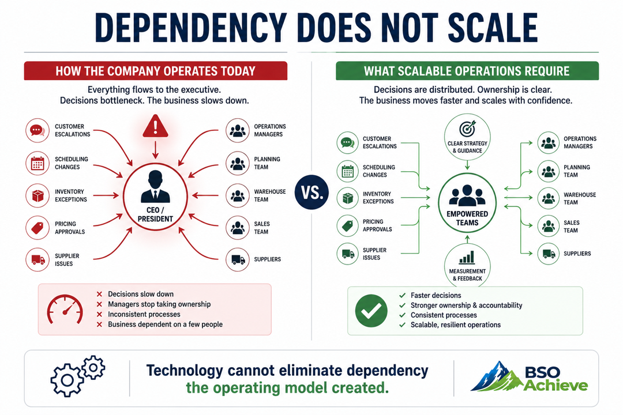
If the CEO is required for daily operational decisions, the company is not scalable.
At a company I worked with nearly every important operational decision flowed through the president.
■ Customer escalations
■ Scheduling changes
■ Inventory exceptions
■ Pricing approvals
■ Supplier issues
Everyone believed this level of executive involvement was a strength.
“It’s how we stay in control.”
But over time, the consequences became clear.
■ Decisions slowed down
■ Managers stopped taking ownership
■ Processes became inconsistent
And the company became increasingly dependent on a small number of executives to keep operations functioning.
The business had grown.
The operating model hadn’t.
This became especially visible during their ERP implementation.
Teams struggled to make decisions without executive intervention.
Requirements changed constantly depending on who was involved.
And accountability became difficult because operational authority had never truly been distributed across the organization.
The issue wasn’t leadership capability.
The issue was organizational dependency.
Many companies don’t realize they are scaling revenue faster than they are scaling operational decision-making.
That creates hidden fragility.
Because scalability is not determined by how much revenue a company can generate.
It’s determined by how consistently the business can operate without requiring executive intervention in routine operations.
Technology alone cannot solve this.
If the operating model, accountability structure, and decision framework are not properly designed, the system simply automates the dependency.
And dependency does not scale.
A business becomes scalable when decision-making capability is built into the operating model rather than concentrated in a few executives.
How Dependent Is Your Business on Its Leadership Team?
Ask yourself:
Can routine operational decisions be made without executive intervention?
Are managers empowered with clear decision rights and accountability?
Would the business continue to operate effectively if key executives were unavailable?
If the answer to any of these questions is no, your operating model may be limiting your ability to scale.
BSO Achieve helps organizations design operating models that distribute decision-making, strengthen accountability, and build the organizational capability required for sustainable growth.
→ Discuss Your Operating Model Alignment
Written by Ted Margison
President, BSO Achieve

Ted helps organizations design operating models that align strategy, governance, processes, systems, and organization into executable business capabilities that achieve measurable business outcomes while strengthening the business.