
Building a Stronger Business with Lean Principles
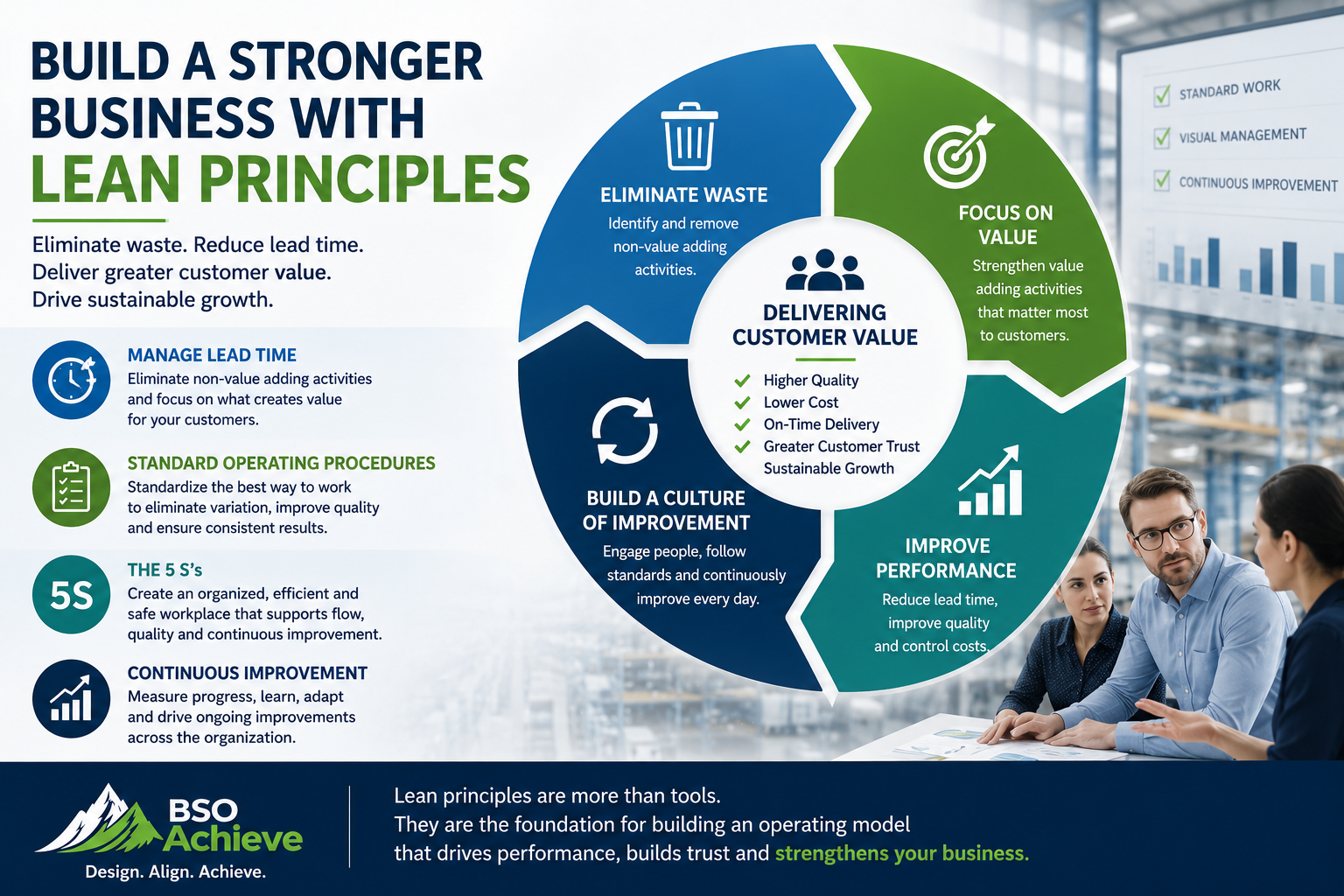
Editor's Note: Lean principles are an important component of designing high-performing operating models. This article explains how organizations can reduce waste, improve consistency, and create greater customer value through Lean practices.
Building a lean culture requires a companywide commitment to efficient & consistent products and services that customers want and trust. There are three Lean Principles outlined in this article: Managing Lead Time, Standard Operating Procedures & 5 S’s. Together they can set the stage to drive and grow your business. Although generally assumed to be associated with manufacturing, “Lean” actually extends to all processes within all types of organizations and companies because the ultimate focus is to provide customer value.
Let’s start with some basic definitions and understandings that hopefully will help position lean in the correct context. Lean is a business strategy that reduces lead time in all processes. This includes engineering, purchasing, production, service and administration. The overall intent of lean is to improve quality, manage costs and deliver a final product that meets customer expectations and is reflective of what the product is intended to provide. Lean, when implemented and followed, is equally intended to provide an organization with a competitive advantage that enables sales and profitability resulting in controlled and planned growth. A successful lean strategy and implementation can create an environment where continuous improvement is a part of an organization’s culture.
Managing Lead Time
A significant, and most say the overall metric of a successful lean strategy, is defined by lead-time. By eliminating waste (non-productive time), lead-time can be reduced and the result is an improvement in quality, cost and delivery. To better understand lead time, it is important to recognize that all work, again not only manufacturing but within any process, consists of one or more of the following three activities:
· Non value adding activity (NVA)
· Necessary non value adding activities (NNVA)
· Value adding activities (VA)
If one interviews personnel in multiple work departments or areas, one will hear repeatedly that I work hard and put in the time. A value adding activity is one that transforms information and materials into products and services that the customer wants. To be considered value adding, an activity must be able generate a “yes” answer to all of the following three specific questions:
1. Was it done right the first time?
2. Did it physically change the information or material?
3. Is the customer prepared to pay for it?
To many organizations, developing work flows and analyzing processes will identify where the true value adding activities exist. Once we have determined where the value adding activities occur, now the challenge is assuring that the activity is in fact being done correctly and without variation. Enter the term standard operating procedures.
Standard Operating Procedures
To all organizations, quality is what is expected. To that end, in the absence of standard operating procedures, the result is variation in process and by definition; variation is the enemy of quality. By determining the least wasteful method of performing a task, quality is improved, cost is reduced and on-time delivery is the final result. By performing a task the same way each time assures consistency and eliminates variation.
As workflows are identified and the standard operating procedures are put in place, the success of these procedures will be directly determined by how effective an organization is at answering the following questions:
· What are the required inputs?
· How were you trained?
· What do you do?
· How do you know your output is good?
· What feedback do you receive?
· Who are your customers?
· What keeps you from doing error-free work?
· What can be done to make your job easier?
· What would you change as the manager?
It is hopefully fair to assume that all employees want to do a good job and would rather do an activity right the first time and not be faced with rework or quality issues. Standard operating procedures, as information or product, are passed from one group to another allowing for consistency in both input and output, resulting in improved quality and happy customers.
The 5 S’s
We have defined our standard operating procedures, are focused on value adding activities, and recognize that quality and happy customers are the end result. We have also recognized that we wish to reduce, if not eliminate, non-value adding activities while simultaneously supporting the need for consistency. In a manufacturing environment, where product is moving from station to station or work cell to work cell, efficiency and consistency are critical. Utilization of the 5 S’s is one vehicle to eliminate non-value adding activities.
· Sort - remove all items from the workplace that are NOT needed for current production.
· Set in Order - arranging needed items so that they are easy to find and put away. Items used often are placed closer to employee.
· Shine - making sure everything is clean, functioning, and ready to go.
· Standardize - the method you use to maintain the first 3S's.
· Sustain - making a habit of properly maintaining correct procedures.
It is important that progress be measured, and as such, an organization should establish a baseline (here is where we are currently) and implement a process to monitor and measure progress. Through the use of pictures and capturing significant performance metrics, progress can be demonstrated and monitored. The one constant in change is change itself. As standard operating procedures are followed, employees and team members will invariably learn of other possible time savers and procedures will be updated to reflect identified areas of improvement and efficiency gains.
Summary
The concepts and practices of lean transcend the manufacturing arena and can be applied throughout any organization. When customer service and product quality are essential, customers turn to those they trust. Trust is built over time and lean helps organizations lay the foundation for building the trust customers seek.
Ask yourself, is building a lean culture right for your organization? Can you implement it without hindering creativity? What does your organization do to set baselines, create marketable standards, and continuously improve? Do customers trust your company?
Continuous Improvement Begins with Better Design
Reducing waste is important.
Standardizing work is important.
Improving lead time is important.
But the greatest improvements occur when every part of the business is intentionally designed to work together.
At BSO Achieve, we help organizations align strategy, governance, processes, systems, and the organization into an executable operating model that supports continuous improvement, scalable growth, and measurable business outcomes.
Design. Align. Achieve.
Written by David Shaffer,
Managing Director, BSO Achieve

David specializes in strategic planning, organization design, operational improvement, executive leadership, and value creation for growing companies and private equity portfolio businesses.