
The System Isn't the Solution — Why SMB Companies Keep Missing the Real Fix
Most SMB manufacturers and distributors believe the solution to a transformation initiative is the system. It isn't — the system is one piece of a broader operating model, and that distinction is exactly where they're giving up control they actually have.
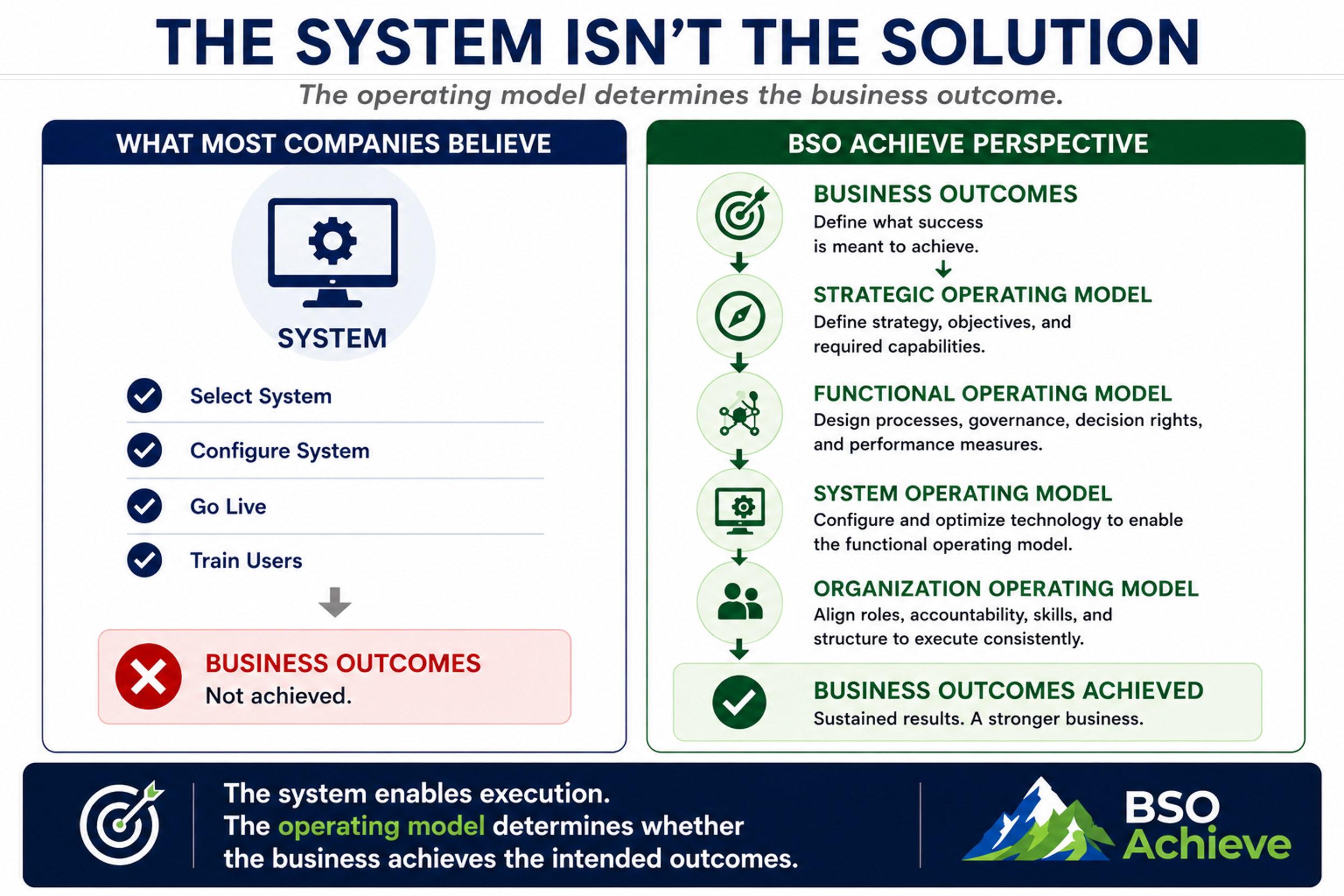
Ask most SMB manufacturers and distributors what their transformation initiative is, and they’ll describe a system implementation: select the ERP, run the methodology, get to go-live.
That’s not wrong. It’s incomplete. And that incompleteness is where the sense of powerlessness comes from.
When “the solution” is defined as implementing a system, the business hands the outcome over to whoever is running that implementation. There’s no other lever to pull. If the system goes live on time and on budget, the business did its part — and whatever happens next is largely out of its hands.
That’s the trap. Not a lack of effort, and not (as leadership often assumes) a lack of internal support. A too-narrow definition of what the solution actually is. It’s how a go-live can hit every milestone — on time, on budget, fully adopted — and still leave inventory unreliable, production planning reactive, and margins unpredictable six months later, with leadership still getting pulled into decisions the business should be able to make without them.
When this happens, most leaders draw one of two conclusions.
Either the system was the wrong choice.
Or the implementer didn’t do their job.
Both conclusions miss the real explanation.
The Real Explanation
A system can only do what the business asks it to do.
If the underlying operating model — the processes, governance, decision rights, and accountability that run the business day to day — was never redesigned around the outcome leadership wanted, the system will faithfully automate the old way of operating.
The go-live succeeds. The business outcome doesn't.
This isn't a failure of technology. It's the predictable result of treating a business transformation as if it were only a digital transformation.
The real solution isn't the system. It's the operating model the system sits inside of — and the system is only one of four layers that make up that model. Once leadership sees the solution that way, the outcome stops being something they're waiting on a software vendor or implementer to deliver, and becomes something they can get.
The Control SMBs Actually Have
Redefining the solution this way changes what's actually within a company's control. It's no longer "did the implementer do a good job." It becomes "did we redesign the operating model the system now runs inside of" — and that second question is one the business can act on directly.
Most SMB leaders also correctly recognize they don't have this specific discipline sitting inside their own organization. That's a real gap. But it's a gap that can be closed by bringing in the expertise; it isn't a reason to hand the outcome over to the system.
The discipline is an Operating Model Architect that covers the four layers of the Operating Model:
✔️ Defining the business outcome the initiative is actually meant to achieve — not just the system going live [Strategic Operating Model]
✔️ Aligning processes, decision rights, and performance measures to that outcome — not leaving them unchanged [Functional Operating Model]
✔️ Leveraging the system to enhance the Functional Operating Model — not letting the system's defaults define it [System Operating Model]
✔️ Making sure roles and accountability evolve alongside the new capability — not assuming people will just adapt [Organizational Operating Model – this is the Executable Operating Model].
Once a company treats these four layers, not the system alone, as the actual scope of the initiative, the business outcomes it was after become achievable — not guaranteed by hope, but the direct result of designing for them.
More Control Than the Sales Process Suggests
Every SMB going through a system selection hears a version of the same pitch: the system will solve the problem.
That pitch isn't dishonest. But it leaves out the part where the business has to do its own work — or bring in someone who can.
The truth is more empowering than the pitch: the business outcome was always more in the company's control than the sales process implied, because the company can choose to focus on the operating model the initiative actually requires, rather than assuming the system alone will carry it.
The system is one input. The operating model — designed deliberately, with the right expertise — is what actually determines whether the outcome shows up.
What This Means in Practice
Every transformation initiative has two objectives, not one.
The first is obvious: achieve the business outcome the initiative was approved for — the margin improvement, the on-time delivery rate, the inventory accuracy the business was after
The second is easy to overlook: strengthen the business itself. These aren’t the same thing, and treating them as if they are is its own trap.
It’s possible to hit the expected outcome and still leave the business worse off — solving a problem in a way that adds complexity the next initiative has to work around, or that only holds together because leadership needs to intervene more often to handle escalations.
A design effort that only asks “did we hit the number” can pass that test while quietly making the business less scalable, less predictable, or more dependent on people than on process. Evaluating a transformation properly means checking both: did it deliver the business outcomes, and did it leave the business stronger.
That second question is where these four characteristics come in. A company needs to evaluate design options and results based on making the business stronger:
Extendable — able to take on new products, markets, or acquisitions without starting over.
Scalable — able to grow without a proportional increase in cost, headcount, or management effort.
Predictable — able to consistently produce the results leadership expects, not results that depend on who's paying attention that week.
Durable — able to withstand a leadership change, a market shift, or a rough quarter without the whole operating model coming apart.
Summary
SMB manufacturers and distributors don't lack the ability to control their transformation outcomes.
They need to change their perspective that the solution was only the system — and focus on designing the operating model needed to deliver the business outcome, without leaving the business more complex, less predictable, or more dependent on leadership intervention than before.
Design. Align. Achieve.
→ Discuss your transformation challenges
Written by Ted Margison, President, BSO Achieve. Ted helps organizations design operating models that align strategy, governance, processes, systems, and organization into executable business capabilities that achieve measurable business outcomes while strengthening the business.