
The Hidden Cost of Operational Complexity
Many companies think they have a growth problem.
What they actually have is a complexity problem.
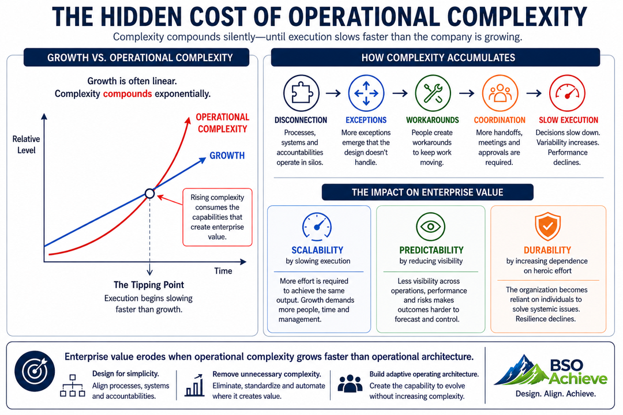
Operational complexity rarely appears all at once.
It accumulates gradually through:
disconnected processes
fragmented accountability
duplicated systems
unmanaged exceptions
inconsistent governance
increasing coordination effort
At first, the organization adapts.
Teams work harder.
Meetings increase.
Workarounds appear.
Leadership becomes more involved.
But eventually complexity begins consuming the capabilities that create enterprise value:
scalability, by slowing execution
predictability, by reducing visibility
durability, by increasing dependence on heroic effort
This is why some companies become harder to operate even when revenue growth slows.
Complexity compounds silently.
Until execution begins slowing faster than the company is growing.
The challenge is that many organizations try to solve complexity primarily with technology.
But technology alone rarely removes operational complexity.
In some cases, it accelerates it.
Sustainable growth requires more than expansion.
It requires operating architecture capable of controlling complexity as the enterprise evolves.
Enterprise value erodes when operational complexity grows faster than operational architecture.
Complexity is inevitable. Whether it limits growth depends on the operating model.
If your business is becoming harder to manage as it grows, the issue may not be growth—it may be an operating model that hasn't evolved with the business.
Design. Align. Achieve.
Written by Ted Margison
President, BSO Achieve

Ted helps organizations design operating models that align strategy, governance, processes, systems, and organization into executable business capabilities that achieve measurable business outcomes while strengthening the business.