
The Most Dangerous Enterprise Problems Are Usually Invisible
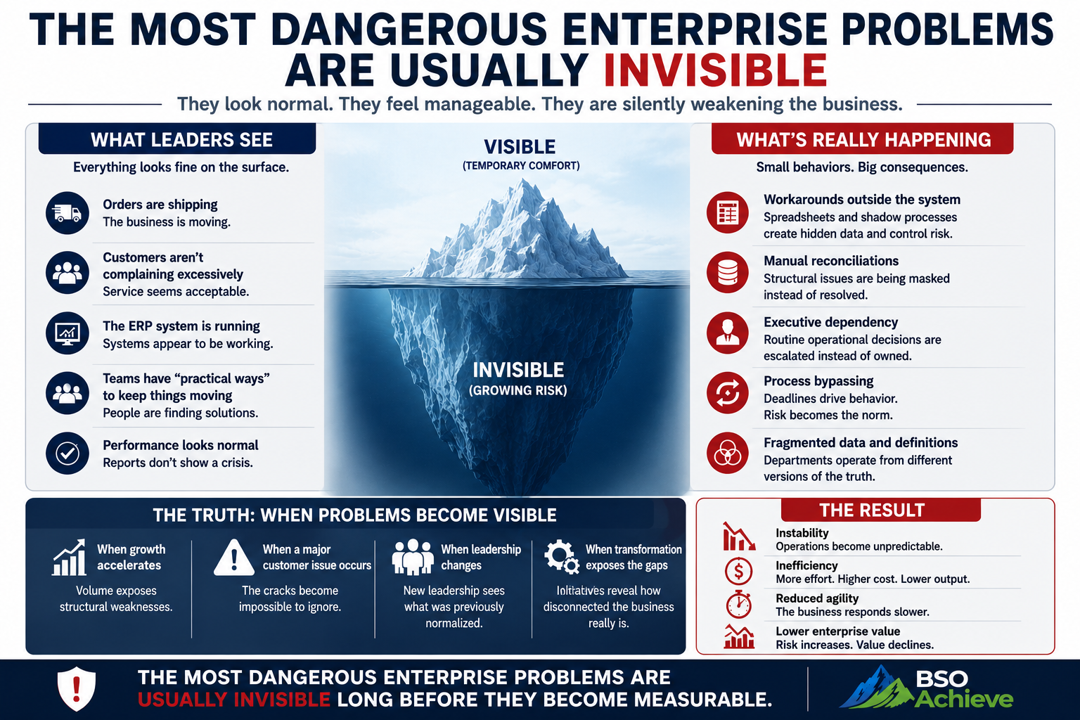
The most dangerous operational problems are treated as normal.
A client believed its operations were functioning reasonably well.
■ Orders were shipping.
■ Customers weren’t complaining excessively.
■ The ERP system was running.
■ And teams had developed “practical ways” to keep things moving.
But underneath the surface, the business was becoming increasingly unstable.
■ Employees were maintaining spreadsheets outside the system
■ Managers were manually reconciling inventory differences
■ Executives were resolving routine operational decisions
■ Teams were bypassing processes to hit deadlines
■ Different departments were operating from different data
None of these behaviors initially appeared catastrophic.
In fact, many had become accepted as “just how the business works.”
That’s what made them dangerous.
Because the most damaging operational problems are often the ones organizations normalize over time.
The issue usually isn’t a single catastrophic failure.
It’s the gradual accumulation of invisible operational dependency, inconsistency, and fragmentation.
And those problems rarely become fully visible until:
■ Growth accelerates
■ A major customer issue occurs
■ Leadership changes
■ A transformation initiative exposes how disconnected the business actually is
This became especially clear during system implementation efforts.
Teams discovered:
■ Processes worked differently across departments
■ Data definitions were inconsistent
■ Accountability was unclear
■ Operational decisions depended heavily on tribal knowledge
Many companies believe digital transformation will eliminate operational instability.
But technology often amplifies the consequences of operational design problems that already existed.
Because systems scale behavior.
Including dysfunctional behavior.
The most dangerous enterprise problems are usually invisible long before they become measurable.
Invisible Problems Don't Stay Invisible Forever
The spreadsheets.
The workarounds.
The executive interventions.
The inconsistent processes.
These aren't isolated operational issues.
They're signals that the operating model may no longer support the business you're trying to build.
Operational problems don't become expensive when they appear. They become expensive when they've been accepted for so long that no one questions them anymore.
BSO Achieve helps organizations identify and eliminate those hidden barriers before they limit growth, undermine transformation, or prevent the business from achieving its intended outcomes.
Design. Align. Achieve.
Written by Ted Margison
President, BSO Achieve

Ted helps organizations design operating models that align strategy, governance, processes, systems, and organization into executable business capabilities that achieve measurable business outcomes while strengthening the business.